
Call Golden I Construction
Melamine is a good material for the parts of a cabinet you do not see and a fair one for the parts you do, provided the edges are sealed and water is kept away from the core. It costs less than solid wood, looks the same on every door and wipes clean. Its weak points are chipped edges and a core that swells if it gets wet.
What melamine is
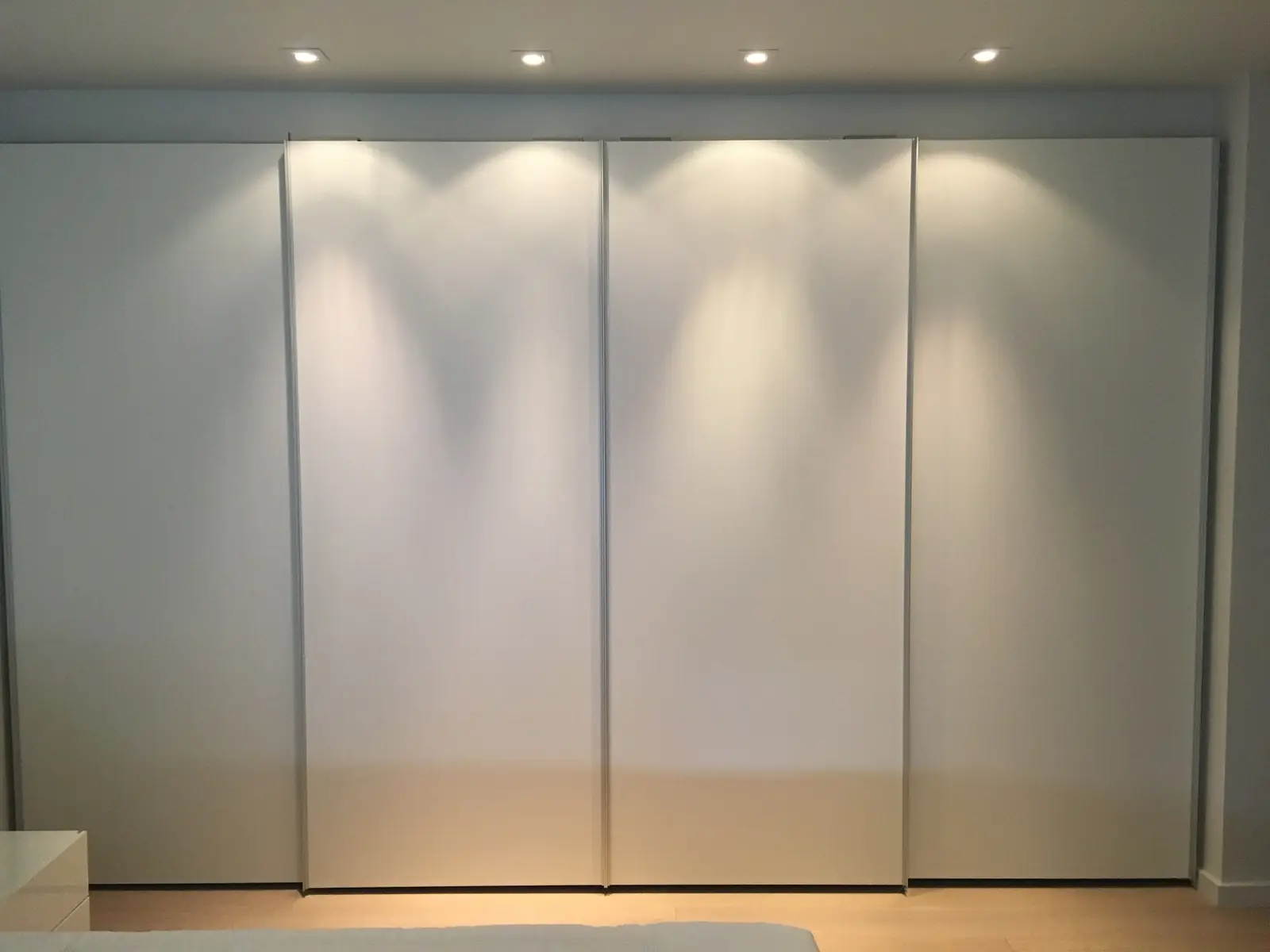
Melamine cabinets are made from a board with a core of compressed wood particles and a hard decorative face. The trade now calls the material thermally fused laminate. A decorative paper saturated with resin is fused straight onto particleboard or MDF under heat and pressure, and the press can emboss the face to imitate wood grain or stone (Composite Panel Association). The color and pattern are in that paper, which is why the range is so wide.
Where it does well
- A tough face. The fused surface stands up to the ordinary moisture, heat and stains of a kitchen, resists scratches and wear, and cleans with a damp cloth.
- A wide choice. It is made in almost any color, in wood grains and in textures, so it is easy to match to a room.
- A uniform finish. Solid wood varies in grain and color from board to board. Melamine comes from a controlled process and every panel matches.
- A lower price. It costs much less than solid wood.
Where it falls short
- Weight. The boards are dense, so the cabinets are heavy. Wall cabinets have to be hung on proper fixings into something solid, or they can come off the wall and take the dishes with them.
- Chipping. The face is hard but thin. A knock on an edge or a corner can chip it and show the core, and a chip cannot be sanded out and refinished the way wood can.
- Fixings. The particle core can split or crumble if nails or screws are driven in carelessly. It wants the right fittings and an installer who knows the material.
- Water at the core. The face sheds water. The core does not. If water gets in through a chip, an unsealed edge or a cut-out for a pipe, the board swells and does not recover. It takes up water more readily than solid wood.
What to check before you buy
- Edges. Every exposed edge should be banded, including the bottom edges and the cut-outs for pipes under the sink.
- Core. Ask whether it is particleboard or MDF, and how thick the panels are.
- Label. Particleboard and MDF sold in the United States, and finished goods made from them, must be labeled as TSCA Title VI compliant, the federal standard for formaldehyde emissions (EPA). Look for it.
- Hardware. Open a door and see what the hinges and drawer slides are screwed into.
- The sink cabinet. Ask how its floor and its cut-outs are protected, because that is where water will get in first.
- A full-size sample. Judge a whole door, not a chip of color.
Where it makes sense
A sound and common arrangement is melamine for the cabinet boxes and the shelves inside, with doors and visible panels in wood or a painted finish. You get the wipe-clean interior and the saving where nobody looks, and the material of your choice where everybody does. It is also a practical choice for closet interiors and other storage away from water.
Melamine doors make sense where the budget is tight and the kitchen is treated gently. They are a poorer choice right beside the sink and the dishwasher, or in a household that is hard on its cabinets.
See it before you decide
Handle the material next to the alternatives. Our page on custom cabinets in NYC describes the cabinet showroom, and our article on visiting kitchen showrooms lists what to look at once you are there. For closets and built-ins see custom storage, and for cabinets as part of a whole project, kitchen renovation in NYC.
Trying to choose a cabinet material? Call us and we will show you the options side by side.
Questions people ask
Is melamine the same as laminate?
They are relatives. Both begin as resin-saturated decorative paper. In melamine, now called thermally fused laminate, the paper is fused directly onto the board. High-pressure laminate is a separate sheet that is made first and then glued on.
Are melamine cabinets waterproof?
The face resists water and wipes dry. The core does not. Wherever water can reach the particleboard, through a chip, a raw edge or a pipe cut-out, it swells for good. Sealed edges and a dry sink cabinet are what keep melamine sound.
Can melamine cabinets be refinished?
Not the way wood can. The surface cannot be sanded back and stained, and a chip is hard to repair invisibly. Choose a color you will be content with for the life of the cabinets.