
Call Golden I Construction
There is no single best countertop. There is a best one for how you cook and how much looking after you will do. A showroom offers hundreds of colors and patterns, but they belong to about ten kinds of material, and each kind behaves in a known way. Choose the kind first, by your habits, then the color.
Two questions settle most of it. Do you prepare food directly on the counter and cook hard, with hot pans, lemons and red wine? Then avoid soft, porous stone. And will you wipe, oil or seal a surface on schedule, or do you want to forget it is there?
| Material | Strengths | Watch for |
|---|---|---|
| Granite | Hard, takes heat well, wide range of colors, few visible seams | Many granites need sealing from time to time; can be costly |
| Marble | Striking natural pattern, cool surface that suits pastry | Softer; acids such as lemon and vinegar etch it; needs regular sealing |
| Soapstone | Needs no sealing | Soft; shows knife marks and scratches |
| Slate | Needs no sealing | Brittle, most of all at corners |
| Engineered quartz | Hard, even in color, low maintenance | Costly; protect it from hot pans |
| Concrete | Smooth, made to any shape, can carry color or inlays | Needs sealing and a skilled maker; costly |
| Solid surface | No visible seams, repairable, non-porous, matching sinks | Marks from heat, knives and scratches |
| Laminate | Lowest cost, hard-wearing, quick to fit | Not heat resistant; can chip or scratch |
| Tile | Affordable, endless colors, ceramic is non-porous | Grout lines need regular cleaning |
| Wood | Warm, an ideal work surface, heat resistant | Needs regular care; shows knife marks; wide planks can warp or crack |
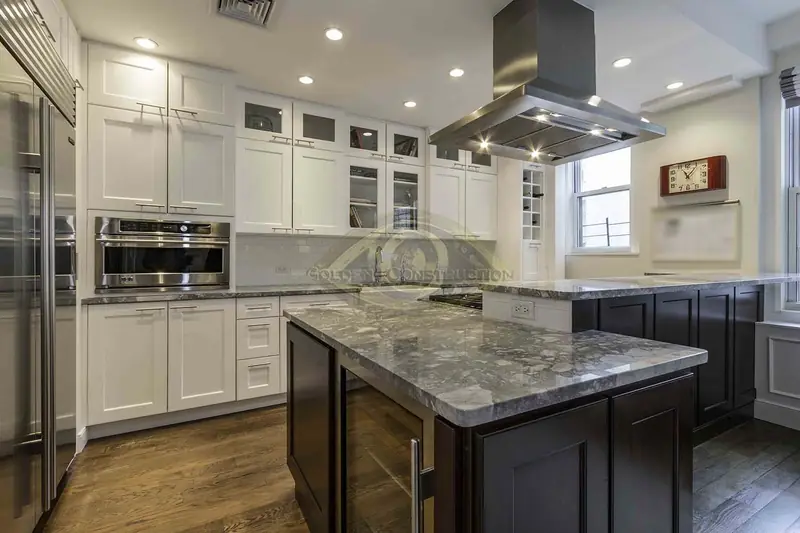
Natural stone
Granite is the common choice for good reason: it is durable, shrugs off heat and comes in everything from white to midnight black. Marble is softer and more refined, a fine surface for baking that will show knife scars and dull spots where acid has sat. The Natural Stone Institute explains the difference in plain terms. Stones made mostly of silicates, such as quartz and feldspar, resist most kitchen acids, while calcareous stones, made mainly of calcium carbonate, can be dulled or etched by products containing lemon, vinegar or other acids. It also notes that sealing makes stone more stain resistant, not stain proof, and that even where stone withstands heat a trivet is recommended (Natural Stone Institute).
Soapstone and slate need no sealing. Soapstone is soft and will show marks; slate can chip at an edge.
Engineered quartz
Engineered stone is ground quartz bound into slabs. It is hard, consistent from slab to slab and asks for little care. The care instructions of one large maker say hot cookware should always go on a trivet or hot pad and that a cutting board should always be used.
Concrete and solid surface
Precast concrete counters are smooth and flat and can be colored or set with glass. They are heavy, need sealing and need a specialist to make and fit them. Solid surface, an acrylic or polyester material, goes the other way: pieces are fused so the joints disappear, which suits a long run, and a matching sink can be part of the same piece. It scratches and scorches more easily than stone, but damage can be sanded out.
Laminate, tile and wood
Laminate costs least and wears better than its reputation, as long as hot pans stay off it. Tile gives the widest choice of color for little money, with grout as the price. Wood counters come as edge grain, long strips glued with the edge up; end grain, the true butcher block, with short blocks set on end; and wide plank, the most handsome and the most likely to warp or crack. Wood is the kindest surface to work on and needs the most regular care.
When the counter is chosen and fitted
Choose the material while the kitchen is being designed, with the cabinets, backsplash and appliances in front of you, since it has to sit with all of them. Fitting comes late. On our kitchen remodel timeline the template for the counters is made after the cabinets are installed, and the counters go in after that, followed by the backsplash.
In an apartment, ask one more question early: how the slab gets upstairs. Buildings commonly keep a contractor to the service elevator, at times the superintendent sets, and the slab has to fit inside it. If a long piece will not fit, the fabricator plans a seam, and it is better to choose where that seam goes than to discover it on delivery day.
The sink is chosen with the counter, since the way it mounts depends on the material; see our guide to the best kitchen sinks. For the whole job, see kitchen renovation in NYC, and for finished examples the kitchen gallery.
Want to see and touch the materials before deciding? Call us or send the request form to arrange a visit to the showroom by appointment.
Questions people ask
Which countertop needs the least maintenance?
Engineered quartz, solid surface and laminate need no sealing and only ordinary cleaning. Among natural stones, soapstone and slate need no sealing either, though soapstone marks easily.
Is marble a bad choice for a kitchen?
Not if you accept how it ages. Marble is a calcareous stone, so acids such as lemon juice and vinegar can dull or etch it, and it shows knife marks. Bakers value it for its cool surface. If you want a counter that looks new for years, choose something harder.
Can I put a hot pan on granite or quartz?
Use a trivet on both. The Natural Stone Institute recommends trivets or mats even though many stones can withstand heat, and the quartz maker whose care instructions we read tells owners to place hot cookware on a trivet or hot pad.