
Call Golden I Construction
The average kitchen in New York City is smaller than one in the suburbs, so storage has to come from places a bigger kitchen can afford to waste: the height above the wall cabinets, the depth at the back of the base cabinets, and the corners. The options below are in rough order of how much space they give back. Start by listing what you own, because the right mix depends on whether you are storing stockpots or wine glasses.
Cabinets to the ceiling
A gap above the wall cabinets collects dust and stores nothing. Running the cabinets up to the ceiling, with a second tier of doors for things used a few times a year, is often the largest single gain in an apartment kitchen. Custom cabinets are made to the height of your ceiling and the width of your wall, so nothing is lost to filler strips. That is the case for them in a small room.
Drawers instead of doors below the counter
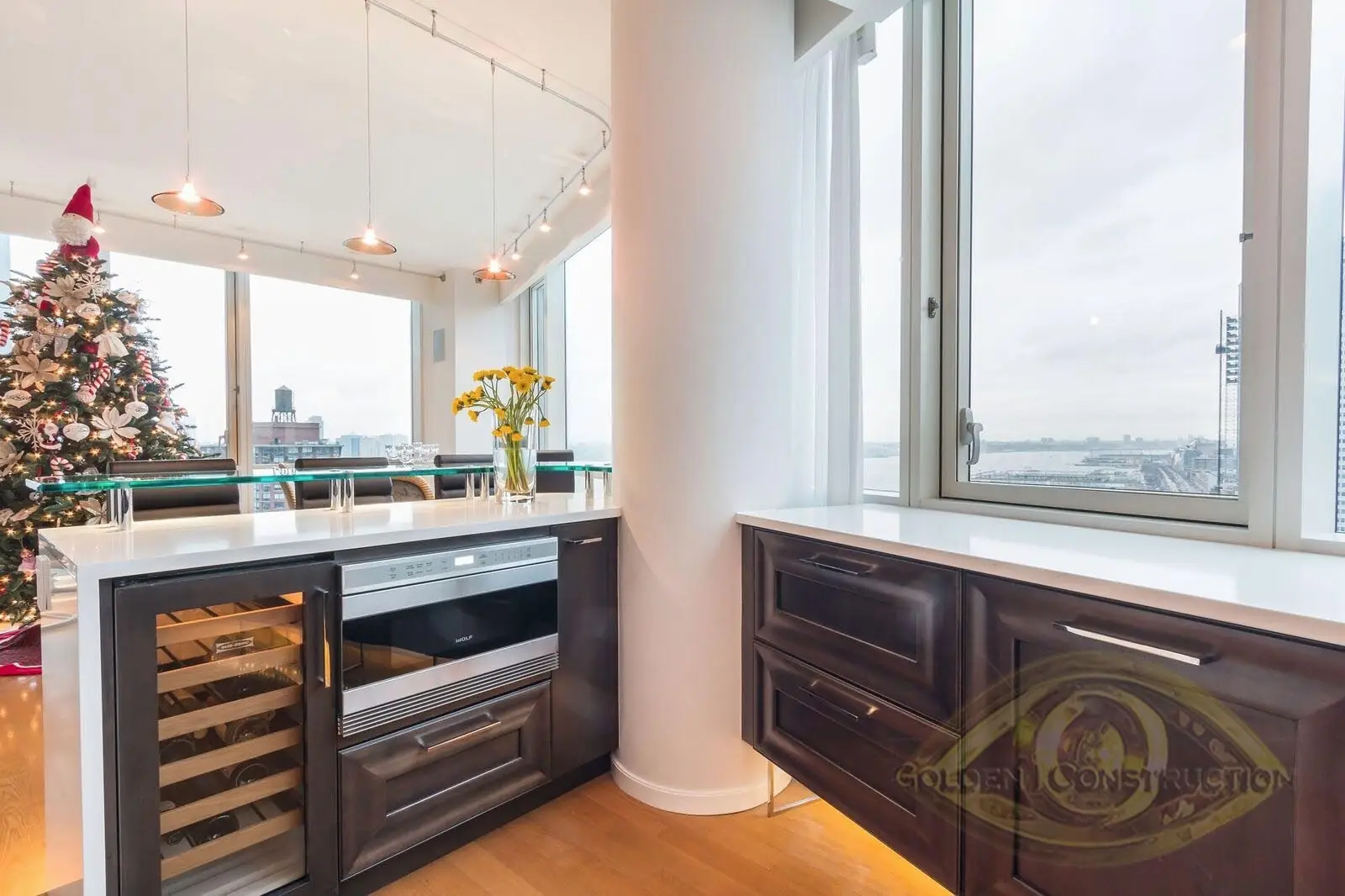
A base cabinet with a door and a fixed shelf hides whatever is at the back. Deep drawers and sliding shelves bring the back of the cabinet out to you, so the full depth is usable and nothing is lost behind the first row. Pots, pans and their lids, plates, and dry goods all store better in drawers.
Corners
A corner is the hardest place to reach in any kitchen. A cabinet built for it, with shelves that pivot or pull out, turns a dead box into working storage. In a kitchen with two short runs, the corner is a large share of the base cabinet space, so it is worth designing and not just filling.
Fittings made for what you store
The inside of a cabinet can be tailored as closely as the outside. Options we build into kitchens include:
- Slotted storage for serving trays, baking sheets and cutting boards
- Pull-out bins for waste and recycling
- Plate racks and wine racks
- Cutlery dividers and a drawer for spices
- Pivoting shelf systems
- Pull-out or lift-up shelves for a mixer or food processor
None of these adds a cubic inch. What they do is let you use the inches you have, and keep the counter clear.
Hang the pots and pans
A rail on the wall or a rack over the counter takes the bulkiest things out of the cabinets altogether, and gives the kitchen a working look many people like. It suits cooks who use their pans daily. Pans that hang in the open need to be clean and need a wall that can take the load.
Open shelves in place of some cabinets
Shelves can go where a cabinet cannot, and without the bulk of a box and doors they make a small kitchen look larger. The trade is honest: everything on them is on show and gathers dust and cooking grease. They work best for what you use every day, with closed cabinets for the rest.
An island, if the room allows
If there is room, an island adds counter and a bank of drawers at once. The test is the aisle around it. The National Kitchen and Bath Association recommends a work aisle of at least 42 inches for one cook and 48 inches for more than one. Where the room cannot give that, a narrow peninsula or a cart on wheels gives some of the benefit without blocking the way.
Choosing among them
Ask your kitchen designer to take an inventory of what you own before the cabinets are drawn. The inventory decides how many drawers, how tall the shelves and whether the mixer gets a lift or a place on the counter. Storage planned this way is part of the cabinet order, which is why it belongs at the start of a renovation and cannot easily be added at the end.
See custom cabinets and the showroom for how our cabinets are made and where to see them, custom storage and closets for the rest of the home, and kitchen renovation in NYC for the whole job. If your kitchen is very small, our piece on remodeling a small kitchen in NYC goes further.
Running out of room in your kitchen? Call us or send the request form, and ask about a visit to the showroom, which is open by appointment.
Questions people ask
What adds the most storage to a small kitchen?
Taking the wall cabinets up to the ceiling and replacing fixed shelves below the counter with deep drawers. Together they use the height and the depth that most small kitchens waste.
Are open shelves a good idea in a small kitchen?
For everyday dishes and glasses, yes: they fit where cabinets cannot and make the room feel larger. Whatever sits on them is on view and collects dust and grease, so keep closed cabinets for everything else.
Do I have room for a kitchen island?
Measure the aisle that would be left. The National Kitchen and Bath Association recommends a work aisle of at least 42 inches for one cook. If you cannot keep that, consider a peninsula or a movable cart.